
No community ratings yet on FilmStash · 0 membersOne score per member · Verified member ratings
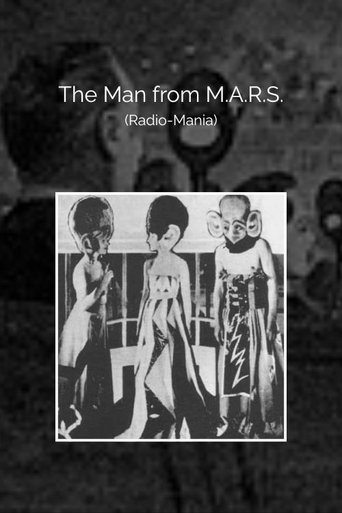
An inventor makes contact with Mars via television. The film is notable for using the 3-D process called Teleview, similar to today's alternating frame 3-D systems. Shown in 3-D only at the Selwyn Theater in New York City, it was previewed as Mars Calling at a trade and press screening on 13 October 1922, premiered as M.A.R.S. on 27 December 1922, and ran through 20 January 1923. A 2-D version was distributed as Radio-Mania in 1923–1924.Read moreLess
An inventor makes contact with Mars via television. The film is notable for using the 3-D process called Teleview, similar to today's alternating frame 3-D systems. Shown in 3-D only at the Selwyn Theater in New York City, it was previewed as Mars Calling at a trade and press screening on 13 October 1922, premiered as M.A.R.S. on 27 December 1922, and ran through 20 January 1923. A 2-D version was distributed as Radio-Mania in 1923–1924.
The story
An inventor makes contact with Mars via television. The film is notable for using the 3-D process called Teleview, similar to today's alternating frame 3-D systems. Shown in 3-D only at the Selwyn Theater in New York City, it was previewed as Mars Calling at a trade and press screening on 13 October 1922, premiered as M.A.R.S. on 27 December 1922, and ran through 20 January 1923. A 2-D version was distributed as Radio-Mania in 1923–1924.
Cast & crew
 Grant MitchellArthur Wyman
 Margaret IrvingMary Langdon
Explore the crew
- Director
- Roy William Neill
- Director of Photography
- George J. Folsey