
No community ratings yet on FilmStash · 0 membersOne score per member · Verified member ratings
"Bill Brown's Roswell [...] takes a fanciful look at the supposed crash of a flying saucer near Roswell, New Mexico in 1947. [...] Brown...seems to take the event seriously. He wonders what the craft was doing in Roswell of all places, speculating that it was piloted by a 'star boy...joyriding through the cosmos' who 'got lost and lost control.' But Brown also sees his subject playfully, as if through a child's eyes, [...] The fish-eye lens used for some landscape shots curves the horizon line, making the sky seem enclosed-- navigable, traversable. In the film's strongest image, Brown stands facing the camera with a sheaf of papers in hand, as an animated drawing of a spaceship scoots across the paper, suggesting a connection between UFO fantasies and the magical possibilities of cinema." -Fred Camper, Chicago ReaderRead moreLess
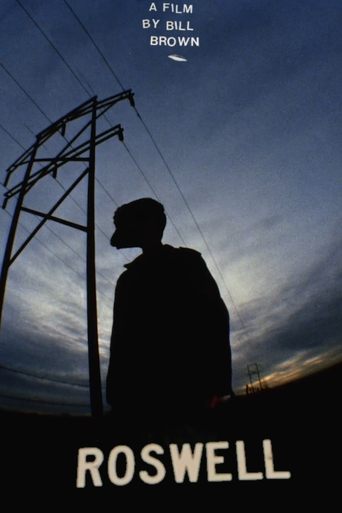
"Bill Brown's Roswell [...] takes a fanciful look at the supposed crash of a flying saucer near Roswell, New Mexico in 1947. [...] Brown...seems to take the event seriously. He wonders what the craft was doing in Roswell of all places, speculating that it was piloted by a 'star boy...joyriding through the cosmos' who 'got lost and lost control.' But Brown also sees his subject playfully, as if through a child's eyes, [...] The fish-eye lens used for some landscape shots curves the horizon line, making the sky seem enclosed-- navigable, traversable. In the film's strongest image, Brown stands facing the camera with a sheaf of papers in hand, as an animated drawing of a spaceship scoots across the paper, suggesting a connection between UFO fantasies and the magical possibilities of cinema." -Fred Camper, Chicago Reader
The story
"Bill Brown's Roswell [...] takes a fanciful look at the supposed crash of a flying saucer near Roswell, New Mexico in 1947. [...] Brown...seems to take the event seriously. He wonders what the craft was doing in Roswell of all places, speculating that it was piloted by a 'star boy...joyriding through the cosmos' who 'got lost and lost control.' But Brown also sees his subject playfully, as if through a child's eyes, [...] The fish-eye lens used for some landscape shots curves the horizon line, making the sky seem enclosed-- navigable, traversable. In the film's strongest image, Brown stands facing the camera with a sheaf of papers in hand, as an animated drawing of a spaceship scoots across the paper, suggesting a connection between UFO fantasies and the magical possibilities of cinema." -Fred Camper, Chicago Reader
Cast & crew
 Bill BrownNarrator
Explore the crew
- Director
- Bill Brown